01
REFERENCE COMPANION
Rife Frequency Reference Companion
A source-aware guide to units, teaching examples, historical context, and the limits of frequency lists.
Download reference PDFTHE BOOK. THE CONTEXT. THE NEXT STEP.
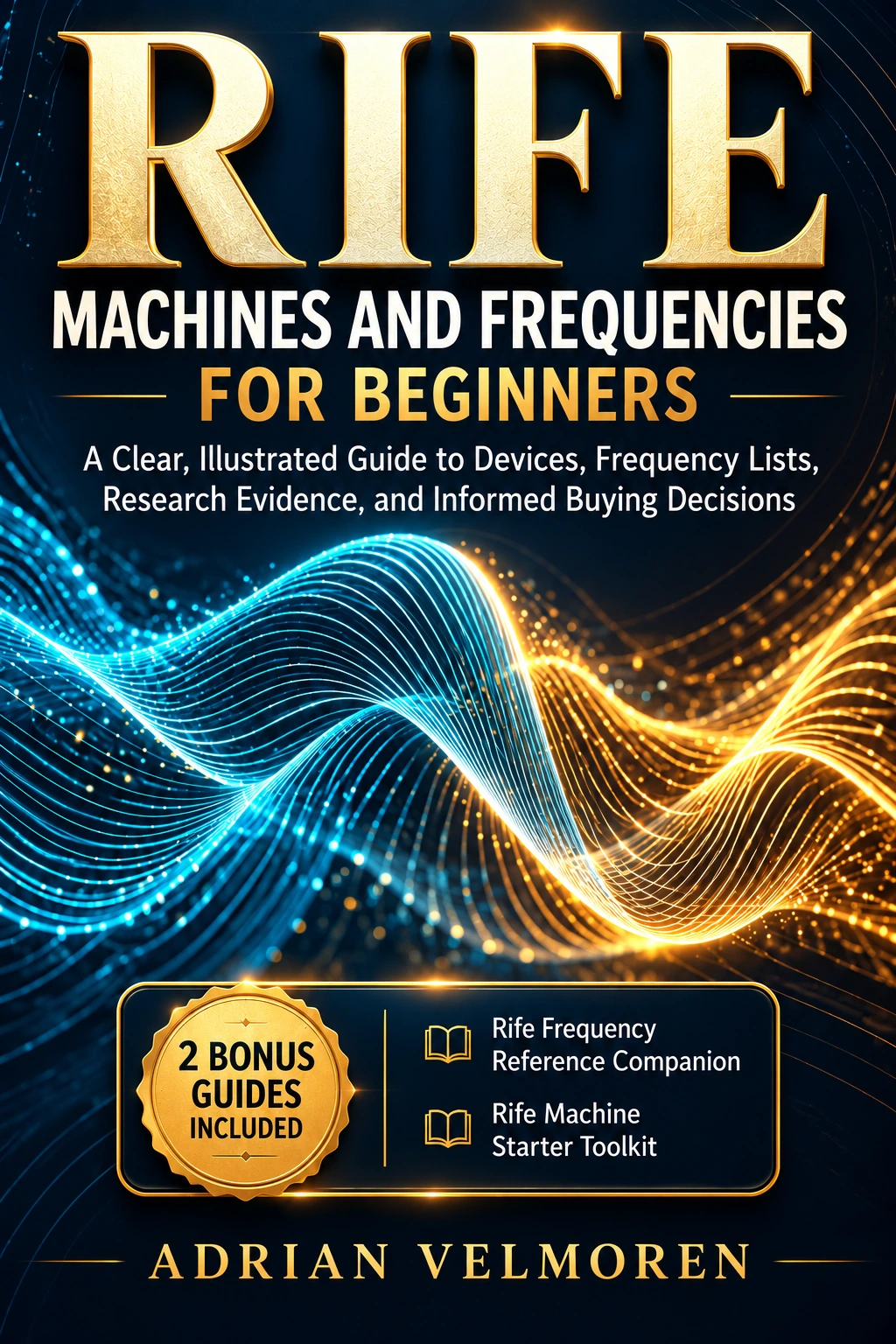
A Clear, Illustrated Guide to Devices, Frequency Lists, Research Evidence, and Informed Buying Decisions
Make sense of the signals.
Go further with your guide.
Your companion space for practical resources, interactive explanations, and a closer look at the evidence.
Three free PDFs. No email, account, or payment.
01 / YOUR BONUS LIBRARY
Three companions. Ready when you are.
REFERENCE COMPANION
A source-aware guide to units, teaching examples, historical context, and the limits of frequency lists.
Download reference PDF
PRINTABLE WORKBOOK
Compare specifications, organize equipment records, and prepare clear questions for manufacturers.
Download printable PDF
FILLABLE WORKSHEETS
Type into equipment records and source-review worksheets. Save a personal copy in a compatible PDF app.
Download fillable PDF02 / EXPLORE RIFE MACHINES
A familiar name does not mean identical hardware—or equivalent evidence.
The name is used for devices marketed around frequency-based health claims. It refers back to Royal Raymond Rife’s work in the early twentieth century. Today, the label alone does not specify a single design, signal, or output method.
Keep three questions separate: what happened historically, what a device produces, and what clinical research actually demonstrates.
Read the source notesTest instruments create defined electrical waveforms. A frequency range describes a technical capability, not a medical indication.
Ask: What load and amplitude convention apply?
Products may use electrode accessories. Their specifications, warnings, and output conditions are model-specific.
Ask: What does the exact model’s manual state?
Descriptions may distinguish a carrier from modulation. These numbers represent different signal properties.
Ask: Which quantity does each number describe?
Original conceptual diagrams—not photographs, product recommendations, wiring diagrams, or representations of specific models. Software control and multiple modes can overlap these broad categories.
Range is not accuracy. Resolution is not stability. Amplitude needs a unit, a measurement convention, and a stated load. A technical specification does not establish a therapeutic effect.
03 / INTERACTIVE FREQUENCY LAB
Change one property. See what changes—and what stays the same.
1–10 cycles per second
Arbitrary units—not a device output
Four cycles fit into one second. Each cycle lasts 250 milliseconds.
Frequency changes timing. A higher frequency fits more cycles into this fixed window. Amplitude changes the vertical size.
Ideal shapes have limits. A square wave here switches instantly between ±A. Real equipment has finite rise time and bandwidth.
Learning, not treatment. No audio, electrical output, device connection, or health recommendation is produced.
READ A REFERENCE IN CONTEXT
Preserve the value, unit, and source before interpreting an entry.
04 / WATCH & LEARN
Selected lessons on waves and the language of signals.
FOUNDATIONS / KHAN ACADEMY
Start with the four properties that help you describe a repeating wave.
Watch on YouTube ↗CONCEPTS IN CONTEXT / KHAN ACADEMY
Apply the same vocabulary to sound. Sound waves are not the same physical phenomenon as electrical signals.
Watch on YouTube ↗GO A LITTLE DEEPER / KHAN ACADEMY
See how a mathematical expression describes a traveling wave. A useful next step after the explorer.
Watch on YouTube ↗These lessons explain physics, not Rife treatment claims. Selection does not imply endorsement of every statement by a channel. YouTube opens only when you follow a link; its privacy policies then apply. Availability and captions may vary.
Prefer a technical reference? Read Tektronix’s signal-generator primer ↗
05 / HOW TO EVALUATE A DEVICE
Use this checklist to organize a documentation review. A checked box records your progress, not a judgment of safety or effectiveness.
Session only. Nothing is sent or stored.
Separate frequency range, resolution, accuracy, and stability. Record units, output load, and measurement conditions.
Locate the exact model, hardware revision, current manual, and safety instructions. Mark missing details as “not stated.”
Ask for original documents, dates, and page references. Keep manufacturer statements separate from independent research.
Check operating systems, software versions, licenses, accessories, connectors, and update requirements.
Read warranty, return, repair, and support terms. Include required accessories, subscriptions, shipping, and replacement parts.
Identify precisely what is claimed and what evidence supports it. A technical specification or regulatory-sounding phrase is not proof of a health benefit.
An individual story cannot establish cause and effect. Look for controlled human studies of the exact device, intervention, and outcome, including limitations.
06 / QUESTIONS & ANSWERS
About the book, your resources, and what these examples mean.
Yes. All three PDFs are available directly, without an email address, account, payment, or review.
Choose the 12-page printable toolkit for handwriting and its explanatory material. Choose the 6-page fillable forms to type into equipment and source records. You can download both.
Some browser previews do not support interactive PDF fields or saving changes. Download the file and open it in a PDF app with AcroForm support. Save a copy and reopen it to confirm that your entries were retained.
No. Hertz describes repetitions per second. A value alone says nothing about clinical effectiveness or a suitable device output. The companion and lab use educational examples, not disease-specific treatment frequencies.
No. It draws mathematical waveforms in your browser. The amplitude is in arbitrary units, with no voltage or power output. It does not send instructions to hardware.
The bonus materials provide the project’s teaching examples and documentation checklist. NIST and Tektronix support terminology; Cancer Research UK provides context on Rife-related cancer claims. See the source notes below.
No. They complement the book with worksheets and visual explanations. They are not medical advice, treatment plans, or device endorsements. Do not delay professional care or change prescribed treatment based on frequency claims.
EDITORIAL SOURCES
Project examples: Rife Frequency Reference Companion and Rife Machine Starter Toolkit, available above. External resources reviewed for relevance on October 22, 2026; third-party content may change.